Community work with orphans in Ho Chi Minh City, Vietnam
Project details:
You will be working at one of two orphanages, located in Ho Chi Minh City. Both orphanages were established in 1998 to provide care and an education for disadvantaged children and orphans. There are both male and female children and they are aged between 1 and 18. The children live in the orphanages and the older ones attend school during the day. Many of the male children love football and are keen to take part in outdoor activities. One of the orphanages is run by Buddhist nuns and both rely on the donations of sponsors.
Why the project needs volunteers:
While volunteering in Vietnam on these projects, you'll find they offer valuable support to children and young people from disadvantaged backgrounds, many of whom are orphans. While the children at the projects have access to education provided by the government, they are usually unable to benefit from it fully due to the many complexities in their lives. The support that our volunteers provide allows many of the children to improve their English skills, which will create more opportunities for them, and learn about a new culture. Often the staff members do not have time to give attention to all of the children, and they will really benefit from spending time and doing creative activities with volunteers.
What kind of skills you need to go on this type of project:
Volunteers at these projects should have a genuine love of children and young people. Although you do not require any special skills, any experience working with children or young people would be valuable. Volunteers must be able to use their initiative and be motivated to work without guidance. You should be patient, compassionate, resourceful and imaginative.
Your role as a volunteer:
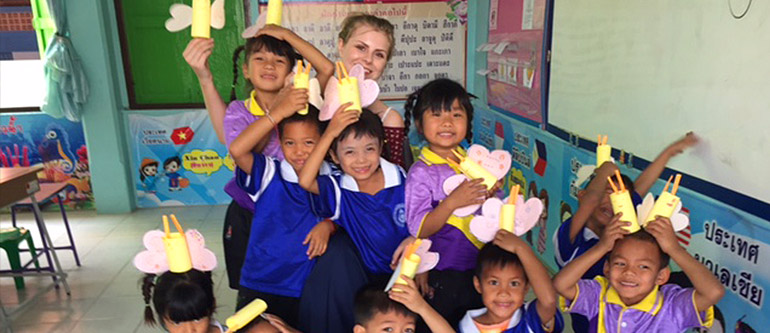
Take the leap and join in volunteer work in Vietnam on these projects. You will be providing essential support to the staff by assisting with daily activities at the orphanages and by offering a positive role model for the children. You may become involved in a variety of activities, including teaching English, outdoor activities, arts and crafts activities, games, songs and social education. Volunteers will be teaching life skills and helping with domestic duties. Your schedule will be flexible and will depend on the needs of the project. You may be asked to help the staff members improve their English or IT skills, or you may become involved with fundraising or improving the appearance of the project.
Where the project is based:
The orphanages are located in the heart of Ho Chi Minh City, Vietnam's largest city. Here you will find traditional street markets and pagodas alongside modern architecture, international cuisine and American cultural influences. Motorbikes are everywhere, and you will find plenty of places to go silk shopping or have clothes tailor-made at bargain prices. You will be staying in a local guesthouse in a residential area of the city, so you will have easy access to local amenities.
US$ 1455.00 for 1 weeks, US$ 195.00 for every week thereafter
Not available.
Early airport pickup available: US$ 45.00
If you are arriving before your designated arrival date, we can arrange for an extra meet and greet service for you. For an extra supplement we will be there to meet you at the airport and take you to the orientation accommodation. Accommodation payment for any extra nights will then be made in country directly to the accommodation (approx 10 USD per night).
40 hour online course included. Ask our expert travel advisers about adding a practical weekend course to your qualification.
Flights, insurance, visa costs and transport (except airport pickup on arrival date) Food (approximately US$50 per week)
Teaching English and life skills, playing, general care role and assistance with domestic duties looking after the children
Generally Monday to Friday, 8 hours a day. You will arrive day 1, your orientation will be held on day 2 and you will start your project work on day 3.
There are very few resources. Any teaching materials you could bring along (story books, magazines, listening cassettes, for example) would be very welcome. Coloured paper, pens, and stickers etc. would also be useful.
Included in your placement fee. Usually shared with other volunteers in one of two family guesthouses. The accommodations are situated between 7kms to 15 kms from the projects.
Meals can be bought from local cafes/restaurants near to your accommodation. You should budget approximately US$50 per week.
CV required for confirmation from the project
What exactly do i-to-i provide?
It may seem like a strange concept to pay for your volunteer experience. You'd be right if you think you shouldn't and the truth is you actually don't! Your placement is free; it's the benefits around it that you pay for. It's important to note that i-to-i is a travel company and not a charity. We provide a professional travel service. We are responsible for finding and assessing worthwhile projects across the world, preparing you for the volunteering experience and supporting you whilst you're there.
Here’s some more information about what your placement fee covers….
Project sourcing and assessment
We work with hundreds of locally run partner projects around the world and are constantly sourcing new opportunities. We visit all projects to check that they are worthwhile and legitimate and we also conduct a thorough safety assessment before we'll send volunteers there. More
Expert help-desk
Almost everyone who works for i-to-i has traveled extensively or worked overseas. This means we're a goldmine of information; we're always available to offer support and guidance before, during and after your trip.
Thorough project briefing materials
Once you book on to a project you'll receive a Welcome Pack that contains loads of general information about volunteering, about your chosen country and project, and a DVD about how to have fun and stay safe. We'll also give you advice on visas and inoculations.
TEFL training
If you are volunteering on a Teaching or Community Development project then a 40-hour Online TEFL course is included in your placement fee. This is an internationally recognised and accredited certificate that will help you to make the most of your time overseas. More
Airport pickup
It can be pretty daunting arriving in a different country for the first time… especially after a long flight! If you arrive on your project start date, there'll be a welcoming face at the airport to pick you up and take you to your accommodation.
Arrival orientation
Soon after you arrive you will attend a thorough orientation with our in-country team. This is to cover important safety and security information. You'll also get some tips about sight-seeing options for your time off and maybe even learn some of the local lingo!
Accommodation and meals
Accommodation is included with all projects and meals are even included with some. We only use locally-owned and operated accommodation so that part of your placement fee is filtering back into the local economy. Most projects offer homestay, guesthouse or shared volunteer houses as standard accommodation, but some offer the chance to upgrade to a more comfortable living standard. More
Local in-country coordinators
Your in-country coordinator (ICC) will pick you up from the airport and conduct your orientation upon arrival. All ICC's are English speaking and are locals of your destination country. They won't be at your project every day, but will be on call 24 hours a day, seven days a week if you need them. More
24/7 emergency support
Aside from the local support from your in-country coordinators you'll be given access to a 24/7 emergency phone line manned by i-to-i staff in case any problem should arise while you're overseas. We also hire crisis management professionals Docleaf to be on hand in case of a situation that requires additional expert support. More
Ongoing training
The safety and security of our volunteers is paramount. For this reason we provide ongoing crisis management and emergency response training to our local teams around the world. At the end of 2006 we flew all our in-country coordinators to the UK for thorough training to help them offer the best safety to the thousands of volunteers they support each year. More
Supporting our projects
We don't fund our projects directly, but once a year they are all invited to apply for funding for special projects or resources from our registered charity arm, the i-to-i Foundation. i-to-i funds the operation of the i-to-i Foundation and is the largest single donor. Along with the generous support of our volunteers, we have distributed over US$200,000 in funding in the last two years alone! More
Recruiting people like you
We make no secrets of the fact that part of your placement fee is reinvested in to recruiting volunteers just like you! The volunteers recruited in one week will typically deliver over 2000 man-days of service. The difference this makes to projects overseas is immeasurable. Many of our overseas projects rely on assistance from international volunteers, so it's necessary for us to put together brochures and websites to find the people who can support them. This recruitment process is vital to ensure programs have a constant stream of reliable volunteers.
The intangible benefits
Volunteering through a company like i-to-i has a lot of intangible benefits to developing overseas communities and the individual projects that we work with. To find out more about our placements. click here
You can book your flights (UK Customers only) and travel insurance through us when you book your project , so you can get your whole trip sorted at once! We'll give you more information about the best deals on flights and travel insurance when you book your project. For the best deals, we advise you book your flights early!
What we will do after you've booked:
- Once booked on you will instantly receive a welcome email confirming your booking with access to your online account
- We will send a Welcome Pack in the post containing further information and a t-shirt, the information in this pack should answer most things you need to know
- Community Development and Teaching customers will receive an email introducing them to their Online TEFL course
- Community Development and Teaching customers will be requested to complete a police check (where relevant) or send through a reference
- We will contact you if we require anything else e.g. CV/resume for some projects, doctors note for medical conditions etc.
- We will hound you to complete your forms and pay your final balance when they are due
- We are available for any questions you may have on 800 985 4852 or operations@i-to-i.com
- We will prepare for your trip and send you an email with final project and accommodation confirmation 21 days before you go
What you need to do after booking your place with us:
- Book your flights
- Arrange suitable travel insurance
- Fill out some extra details through our online interface:
- application from
- travel details
- insurance details
- medical information
- emergency contacts
- Complete your police check or request your reference (where relevant)
- Do your Online TEFL Course (where relevant)
- Make final payment at least 60 days before you go
- Make sure you have a visa for your trip if its needed
- Visit a nurse or travel clinic for advice on inoculations and malaria prevention
- Read all details and prepare as much as you can for your trip
- Take contact details of the in country team and where you're going in your hand luggage - just in case!
- Get on the plane!
Orientation Information
You will arrive on the Arrival Date - Friday and will be met at the airport on that day. You will be taken to your permanent accommodation for your stay, the Nhu Ngoc Guesthouse (see contact details below) where you will have the first day/night to recover from your flight. The Guesthouse is located in the backpackers area in the heart of the city and is close to restaurants, shops, markets,internet services and ATM's.
Note: If you're arriving early we can arrange a meet and greet for you. If you require this please contact us to arrange this service.
If you wish to make your own way please arrange to be at the address below on the arrival date:
Nhu Ngoc Guesthouse 230 De Tham Pham Ngu Lao Ward District 1 Ho Chi Minh City Vietnam Telephone ++84 (0)8 4041459 Contact Mr ThongYour orientation will take place over the weekend and you will be introduced to your project on Monday and will start working as a volunteer.
Country Guide
Vietnam
A little bit of history...
Vietnam’s history has been marred by war and various power struggles as it has sought to regain and maintain independence. Its earliest origins are believed to date back to the Dong Son civilisation circa the 3rd century. Up until the 10th century it was ruled by a succession of Chinese dynasties before it achieved independence. The period up until the mid 19th century saw a series of dynasties including, Ly, Tran and Le, with aims to carve out the country’s own identity against the influence of China.
The country was unable to fend off the dominance of the French Empire and by 1883 the French had overtaken the country. Ho Chi Minh, the founder of the Vietnamese Communist party, was a key force in the country’s quest for independence, and post-WW II he declared the country independent after his communist army defeated French colonists in 1954. At the 1954 Geneva conference the French agreed to withdraw and the country was effectively divided into the communist north and the anti-communist south, which was intended to be temporary and followed by democratic elections. This didn’t turn out as planned when Ngo Dinh Diem, the leader of the south, refused to hold elections and the north began strengthening their communist influence in the south. An armed struggle ensued and the USA, who supported the south, intervened in the early 1960s and was joined by other foreign troops. War raged until a ceasefire in 1973, and two years later the north gained control and unified Vietnam under communist rule.
Stability was not assured and Vietnam incurred the wrath of China when it invaded Cambodia in 1978 which resulted in China attacking Vietnam the following year. Years of fierce combat meant an economy at near collapse which contributed to thousands of refugees fleeing the country in the late 1970s and early 1980s. Aside from Soviet influence, it remained isolated from the world. Economic reforms in 1986 paved the way for a modernised economy and economic growth. Having established diplomatic relations (notably with the USA) the country opened itself up to foreign investment. While it remains one of the world’s poorest countries, it has one of the fastest growing economies in Asia.
Best time to go...
To experience Vietnam at its most weather-friendly, there is no clean cut time of when to go as climate varies between the north, south and central regions. The north is defined by a cool, wet winter from November to April and a hot summer from May to October, during which time typhoons may occur. The temperatures in the north are at their mildest from late September to November and in March and April. To avoid the wet season in the central region which runs from August to December, it’s best to visit between January and July; the coastal regions tend to bear the brunt of the wet weather. The most desirable time to visit the south is between October and February when it’s dry and a respite from the baking temperatures experienced during March through to May. The south’s two main seasons are wet, from May to November, and dry, during the months of December to April, with June to August the wettest period.
The busiest time to visit is typically from November to January and April to June when tourists are out in full, leading to a rise in accommodation rates. A worthwhile, albeit packed, time to visit is during the weeks leading up to the lunar new year, known as Tet, a major holiday in Vietnam. The days change each year depending on the lunar cycle but for 2007 the first day of Tet is earmarked for February 18. During the holiday, there may be limited services and a number of businesses close for three or four days but the build up is the best part if you’re a visitor.
Currency and living costs...
The dong is Vietnam’s unit of currency. The current exchange rate is: $1 to 16,090.00d. Check www.xe.com or equivalent for the most up to date exchange rate.The average costs of life’s little essentials are as follows:
- Meals – main dishes for lunch can cost between 15,000d and 30,000d in restaurants, while dinner is in the region of 30,000d and upwards. Pho, a traditional soup dish containing meat, can be purchased for as little as 2,000d to 4,000d.
- Beer – a bottle of beer can range between 5,000d to 10,000d, whereas draft beer is priced around 2,500d for half a litre.
- Coffee – A cup of coffee is priced between 2,000d and 5,000d.
- Taxi ride – A taxi ride is usually charged from a rate of 14,000d, though it’s possible that some taxis will charge as low as 12,000d and others as high as 16,000d. Most charge between 4,000d and 5,000 per km thereafter.
- Accommodation – A 2* hotel room, depending on season and availability, can be priced at around 320,000d and 650,000d.
- Internet café – Rates per hour differ from as low as 5,000d to up to 15,000d.
Getting around...
For long distances, flying is a doable but often expensive option compared to trains and buses. The main domestic airlines are Vietnam Airlines and Pacific Airlines which offer regular services between major cities; flying time between Hanoi and Ho Chi Minh City is around 2 hours. It’s often cheaper to purchase domestic tickets within Vietnam.
Vietnam has an extensive bus network in place and cheap fares but the buses are all too often overcrowded and road safety is dubious; driving is not recommended. While the fares may still be relatively cheap, foreigners are usually charged more than locals. Aimed at the tourist trade, Open Tour Buses are inexpensive, comfortable buses that journey to the major destinations and stop at selected hotels and restaurants along the way. Although a pleasurable way to travel, it can feel like a tourist bubble rather than an experience of the real Vietnam. Minibuses are also plentiful but can be irritatingly slow with numerous pick ups and drop offs. It’s best to ride express minibuses which have far fewer stops and are air conditioned.
If time isn’t an issue, train travel is a relaxed way to travel. The journeys can take longer than by bus but offer more leg room and are generally less crowded. Also, unlike bus fares, foreigners pay the same as locals. Depending on your travel budget, trains range from the non-air conditioned seated variety to air-conditioned sleepers, the latter being an obvious choice if you plan to brave the 30 hour plus trip from Ho Chi Minh City to Hanoi which is often referred to as the Reunification Express. All trains require a reservation and it’s often possible to book a train from a station other than the one you are departing from.
Aside from crowded buses, taxis are good for getting around major cities. It’s advisable to used metered taxis or at least negotiate a fare before departure. Cyclos, three-wheeled bicycles, are an alternative way of traversing city streets and can be hired for a full day. For a more high-powered mode of transport, Honda Oms, motorbikes whereby the passenger sits behind the driver, are also plentiful. For both modes, it’s best to have a pen and paper to hand to write down your destination and agree on a fare prior to the journey.
Useful links
www.lonelyplanet.comLonely Planet are leaders in the travel guide sector and their website is a great source of travel information.
www.fco.gov.uk
The Foreign & Commonwealth Office’s website provides up-to-date political news, travel advice and information on visas.
www.pacificairlines.com.vn
Pacific Airlines.
www.vietnamairlines.com
Vietnam Airlines.
www.vr.com.vn
Train operator Vietnam Railways.
Why i-to-i
We do everything we can to be a truly responsible travel organisation and we believe that everything we do should minimise the negative aspects of foreign travel and make a positive contribution to the places that our travellers visit.
Our achievements
In the last year alone we have assisted over 6,000 volunteers to have a life-changing travel experience in 34 countries around the world. We are very proud of all the volunteer projects we work with, which are sustainable and produce a positive long-term impact and are equally proud of our volunteers who devote their time and efforts into contributing to the projects which continue to develop communities abroad. Click here to see some of our volunteer achievements.
Our benefits to communities around the world
All of our projects overseas are based in the local community and are local initiatives. When you travel with us, you will stay in locally run accommodation and travel on locally owned transport. In this way we can ensure that the part of your placement fee assigned for transport and accommodation goes directly into the local economy. That means that before you've even lifted a finger on your project, you've already made an important contribution to the local economy.
Our support for our volunteers
We appreciate how special our volunteers are and offer our full support every step of the way. Our in-country coordinators are on-hand for you while you're in-country, providing airport pick-up and arrival orientation while we also provide 24/7 support for all our volunteer travellers.
Against aid reliance
We do not give direct funding to the projects we work with. Many experts believe that the constant flow of financial aid into the developing world causes an over-reliance on foreign aid, which harms the long-term stability of developing economies. It is your time and effort (rather than cold hard cash) that makes a difference. We truly believe that by working together and forging relationships with the developing world, we can make a real and lasting difference.
Your experience
When you travel with i-to-i, you'll experience a truly unique travel adventure which will change your life forever. We're all different, which is why we'll all experience a unique voyage. In addition to gaining a deep immersion into a new culture, you'll learn valuable skills for life which will open-up your eyes to the world and warm your heart in the knowledge that you're giving something real and lasting back to the places you visit.
Why Volunteer through a travel company?
The reason there are so many volunteer providers is not only because volunteering abroad is growing so popular, but because there is a genuine need for companies who can organise your trip for you. Volunteering on your own can be very difficult. Especially if you haven’t travelled very much or are a little soft spoken and arriving in a foreign country without a plan can be rather stressful. Volunteering with a company like i-to-i offers many benefits.
Pre-arranged
You can try searching for a volunteer opportunity on the internet, but you won’t find much that doesn't involve a volunteer travel provider such as i-to-i. Think about it: the places that need volunteers are likely to be poor and underdeveloped - they probably won't even have access to the internet. I’m sure if they had internet access they’d post a volunteer position, but that hardly seems feasible.
It’s virtually impossible to pre-arrange a volunteer opportunity abroad by yourself. Many people don’t want to take the risk of going overseas on their own, with no guarantees of work. An organisation has been there in person and worked out all the finer details for you. They've checked that it's safe, made sure that it's worthwhile and taken the time to make your arrangements for you.
Support
Most organisations offer you support both before and during your trip. Even though you probably won’t have any problems on your trip, it’s reassuring to know that someone is there if you need them. This is particularly comforting for younger volunteers’ parents.
Something as little as meeting you at the airport can really mean a lot. Those first few hours in a foreign country can be really disorienting, and having someone there that can speak the language, knows where they’re going and can help you with your bags is will take a huge weight off your mind.
Time saving
If you decide to just go to Ghana and see what comes up, you could - and probably will - spend a considerable amount of time wandering around looking for volunteer positions. This is not very effective and you could waste a lot of time and money this way. By travelling with a volunteer organisation you avoid all the confused and aimless wandering, and can get straight to work.
Information
If you volunteer with an organisation, they’ll provide you with information about the country you’ll be going to and the project you’ll be working on, as well as general pre-departure information. Some organisations, like i-to-i, provide an in-country orientation. This is a good way to learn about an area and get answers to any questions you might have.
Guaranteed Placement
If you decide to jump on a plane and look in you could find yourself spending hundreds of pounds without actually doing what you can to do - volunteering. Going with a volunteer organisation guarantees you a volunteer position when you arrive, so you won't go home disappointed.
Can I really make a difference
There are good reasons why you pay a placement fee when you volunteer with i-to-i. As a travel company our responsibility to you is wider than if we were a charity. Our focus is not only on the benefits to the project but also on your safety and satisfaction.
The common question and the understandable doubt on the lips of every volunteer before they choose to embark on a volunteer trip is: "Will my contribution actually be worthwhile?" The answer when you volunteer with us? Yes, it definitely will! Whether you volunteer for one week or six months, you will make a difference to communities abroad. After all, what is the point in making the effort to volunteer overseas if you can't be assured that your contribution will really make a difference and have a profound effect on the communities and environments they are aimed at benefitting?
Experts in providing overseas volunteering projects
As an international volunteer organisation with over 12 years experience in sending volunteers abroad to work on vital overseas community and environmental development projects, we are experienced volunteer travel project providers.
Long-term impact
The trouble is that many 'short-term' volunteers can't see the bigger picture or the difference their contribution is making. When you volunteer with i-to-i, you are part of a much greater picture and can rest assured that your work will be continued by future i-to-i volunteers as we make sure all our volunteer projects are sustainable and worthwhile.
Your help is appreciated and really does help!
When you volunteer with i-to-i your contribution will make an immediate and lasting difference which will be thoroughly appreciated by overseas communities.
Why is there a Placement Fee?
There are good reasons why you pay a placement fee when you volunteer with i-to-i. As a travel company our responsibility to you is wider than if we were a charity. Our focus is not only on the benefits to the project but also on your safety and satisfaction.
If a project is badly run, volunteers’ hard work can be for nothing. Your fee helps us to source worthwhile projects so you can be sure you’re making a difference. Accommodation is included in our placements and often, so is food, and by staying locally your fee remains in the community you’re there to help.
We also provide you with thorough information about how to prepare for your trip as well as information on volunteering in your chosen country. What’s more, if you are volunteering as a teacher or on a community development project, we will include our 40 hour TEFL qualification!
Don’t think we forget about you once you’re out there! You’ll be met at the airport and introduced to the local area by one of our in-country co-ordinators so there’s no chance of getting lost! As well as providing you with all the support you need, the self-funding nature of i-to-i means we can continue to support more and more worthwhile projects in the long-term.
In-country Coordinators
We have in-country coordinators in every single country we operate in. They’re there to make sure you're getting the most out of your travel experience by introducing you to the country, answering your questions and dealing with any problems that might arise while you're away. They’re on hand 24 hours a day so, in the unlikely event of an emergency, you know there will always be someone beside you to help you through.
So how will you benefit from our overseas teams?
-
Face-to-face support
Our in-country coordinators are your first port of call if you have a problem. As well as sorting out the little things, they're available 24/7 to help you through any emergencies that you might encounter while abroad. They'll be right there by your side to provide a friendly face and a reassuring word when you need it the most.
-
Airport pick-up
Our in-country coordinators will pick you up from the airport and make sure you get to your project without any problems.
-
Orientation
Your in-country coordinators will give you a full cultural orientation on arrival. This will cover everything from health and safety to where you can get an emergency bar of chocolate.
-
Local
All of our in-country coordinators are local people with a wealth of information about the land and its customs. They'll be able to advise you on where to go, how to get there and what to do while you're there.
-
Friendly
Arriving in a new country can be a daunting experience but our friendly in-country coordinators will be there to settle you in and calm your fears.
-
English speaking
Language barriers can be a huge problem when travelling abroad, but not when you travel with i-to-i. All our in-country coordinators speak English so you won't have any trouble communicating with them.
International conferences
From time-to-time, we hold international conferences designed to encourage global understanding within the i-to-i team and improvement from our in-country coordinators, to ensure our travellers receive the best possible support and service while on a project with us.
The conferences are attended by our in-country leaders, who pass on the knowledge they have learned to their in-country teams. Our global conferences are the perfect opportunity for training and offer quality training sessions on topics including extensive customer service skills, to help raise the level of service across the global i-to-i network.
Our international conferences are vitally important because they allow our in-country coordinators and global staff to share their experience and help to build on our success in answering and fulfilling the changing needs of our volunteers.
Crisis Response Plan
With the help of Docleaf, our crisis management specialist, we have developed a comprehensive crisis response plan to prepare for and guide us through any emergency. We operate a 24/7 emergency support service so that this plan can be put into action immediately no matter what time of the day! Our crisis response plan covers:
Our crisis response plan covers:
- Emergency support
All travelers are issued with the UK based emergency support number in pre-departure literature.
Duty officers
The duty officer is the first point of contact. They deal with any incoming calls and initiate the appropriate response to the crisis. In more serious cases the duty officer will then call a senior officer (a member of i-to-i management) for advice, assistance and support. Should the situation require it, they will activate the full global response team.
- In-country coordinators
We regularly bring our in-country coordinators to the UK for crisis response training, so you can rest assured that your in-country coordinators are well versed in our emergency protocol and will know exactly how to react in the unlikely event of an emergency.
- Crisis response teams
All UK staff have been pre-assigned specific roles which they must take up in the event of a major crisis. Should their services be required these staff will be called into the i-to-i office to take up their role in the crisis response team. The team will co-ordinate the emergency response, advise in-country coordinators, contact insurance providers and organize assistance.
- Emergency travel teams
Should the situation require it, we will mobilize an emergency travel team to assist in-country.
- Global communication
We’ve create a 'triangle of confidence' between the UK response team, the in-country coordinators and the traveller.
- Crisis training
We carry out regular training sessions to ensure all staff are fully informed about our crisis response procedures.
- Docleaf training
Every year i-to-i Staff are fully briefed and simulation trained by DocLeaf.
- Monitoring systems
All i-to-i staff are fully informed of any changes to our crisis response procedures through the company intranet.
Note: i-to-i closely follows global travel advice when it comes to deciding the safety of our travelers abroad. We monitor government communications from the UK Foreign and Commonwealth Office, the US State Department and the Australian Department of Foreign Affairs, to ensure that we can make informed decisions about the risks posed to our customers.
Watch our video
For more information, watch our 'i-to-i support network' video.
i-to-i